

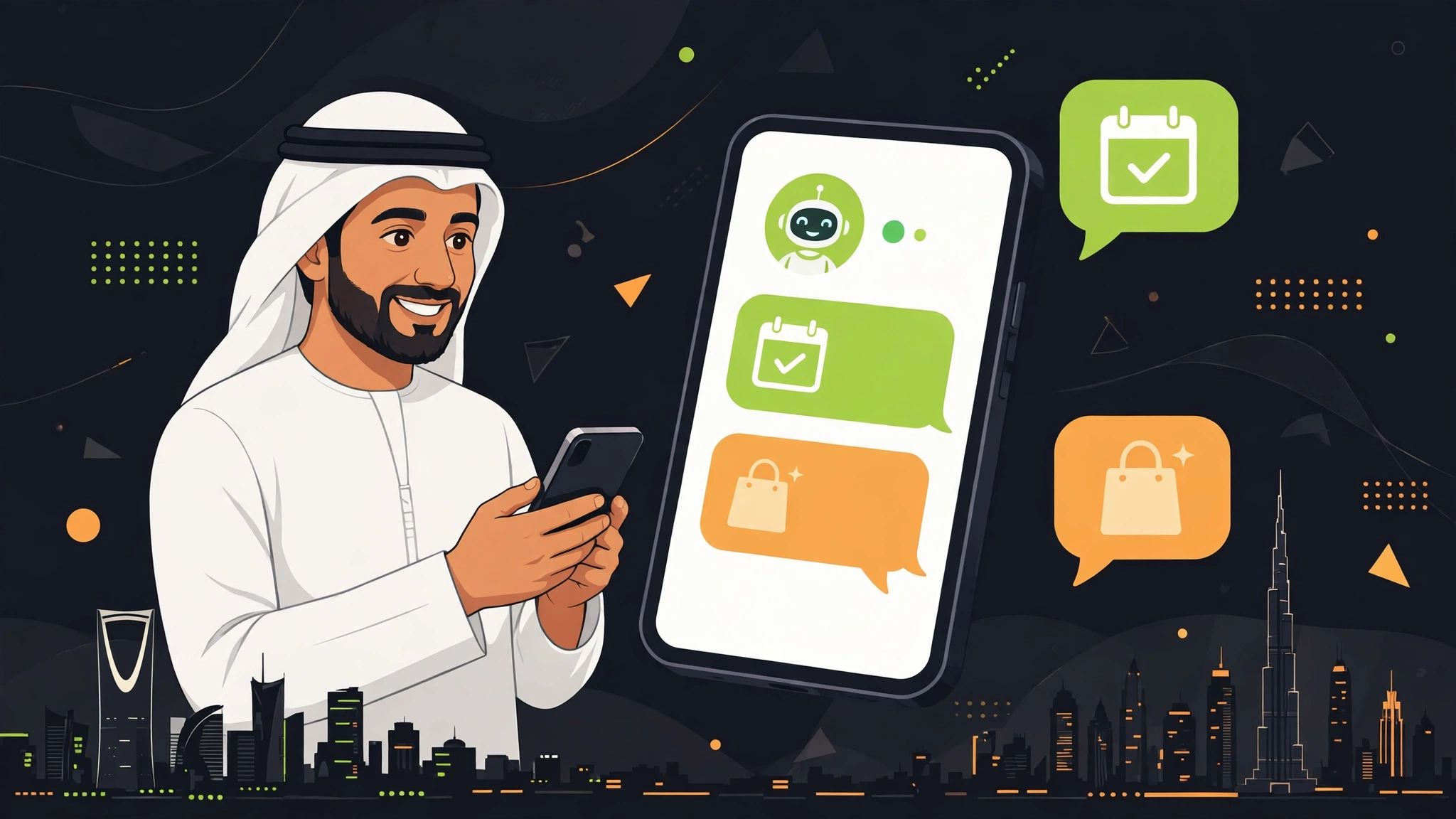
The short answer: Yes, your business can still run an AI assistant on WhatsApp in 2026 — as long as it serves your customers about your business: answering questions, taking orders, booking appointments, tracking deliveries. What Meta banned in its October 2025 policy change (effective 15 January 2026) is general-purpose AI chatbots on the WhatsApp Business Platform — third-party assistants like open-ended AI companions that use WhatsApp as their distribution channel. If you sell, book or support through WhatsApp, the door is open; this guide explains exactly where the lines are and what a compliant build looks like for Saudi and UAE businesses.
What Meta actually changed
In October 2025 Meta updated the WhatsApp Business Platform terms: providers of general-purpose AI assistants may no longer use the Business Platform to deliver those assistants to users. The target was AI companies using WhatsApp as a free front-end for their own chatbots — not businesses automating their own customer conversations.
What remains fully allowed, and is in fact the platform’s intended use:
- Customer support automation — an AI assistant answering FAQs, order status and policy questions for your own customers
- Commerce conversations — product questions, orders, payment links, abandoned-cart recovery
- Bookings and appointments — clinics, salons, real estate viewings, services
- Notifications and updates — delivery status, appointment reminders, statements (via approved template messages)
- Lead qualification — asking the questions your sales team would ask, then handing a warm lead to a human
What is not allowed: building a general-purpose chatbot product on the platform, sending unsolicited promotional blasts outside the messaging rules, or automating a personal WhatsApp number (automation belongs on the official Business Platform/API, not on unofficial tools attached to a regular account — those accounts get banned, and it happens fast).
The rules your assistant must live by
- The 24-hour window. You can reply freely within 24 hours of the customer’s last message. Outside that window, you may only send pre-approved template messages (utility or marketing categories, with different pricing and rules). Your assistant’s flows must be designed around this.
- Opt-in first. Customers must have agreed to receive WhatsApp messages from you — a checkbox at checkout, a “chat with us” button, a QR code at your counter. Bought number lists are a ban risk and, in Saudi Arabia, a legal problem too.
- Templates need approval. Every template message is reviewed by Meta before use. Utility templates (order updates, reminders) are cheaper and safer than marketing ones; plan your flows accordingly.
- A human exit. Customers must be able to reach a person. The best-performing assistants hand over early and gracefully — an AI that traps an angry customer in a loop damages the brand it was meant to help.
- Per-message pricing. Since Meta’s move to per-message pricing, every template message costs money (rates vary by country and category). A good build minimises paid messages: answer inside the free window, batch updates, and don’t spam.
The GCC layer: Saudi Arabia and the UAE
This is where generic global guides stop and regional reality starts — and it is the market MaxCore delivers in most (13 projects across Saudi Arabia, the UAE and Oman).
- Language. Your customers will write in Arabic, English, and a mix of both in the same conversation. A GCC assistant must handle Arabic properly (including dialect-flavoured phrasing) and switch languages mid-thread without losing context.
- Saudi PDPL & UAE data law. Saudi Arabia’s Personal Data Protection Law and the UAE’s federal data protection law both apply to customer data your assistant collects and stores. Practical consequences: host and process data with a provider you can name, keep conversation data only as long as you need it, and be able to delete a customer’s data on request. “The AI vendor handles all that” is not a compliance answer.
- Payments. GCC customers expect mada, Apple Pay, Tabby and Tamara alongside cards. Your assistant should hand off to payment links that support them, not a generic checkout.
- Commerce habits. In the GCC, WhatsApp is the storefront for a large share of SMBs — catalogue questions, voice notes, and “send me the location” are normal customer behaviour. Voice-note handling (transcribe and respond) is not a luxury feature in this market; it is table stakes.
What a compliant build looks like
A typical MaxCore build for a GCC business runs: (1) Scope — pick one job first (support FAQs, bookings, or order tracking — not all three at once). (2) Knowledge — train the assistant on your real documents: price lists, policies, FAQs, product data. (3) Flows + guardrails — scripted paths for money and bookings, AI answers for questions, hard rules for what it must never promise, and human handover triggers. (4) Templates — draft and submit the utility templates (reminders, updates) for Meta approval. (5) Pilot — live with one number, real customers, two weeks of conversation review before expanding. Milestone-based, with full IP transfer — the same engagement model we use across our AI and automation work.
Frequently asked questions
Is using AI on WhatsApp Business legal in Saudi Arabia? Yes, for your own business’s customer conversations, using the official WhatsApp Business Platform — provided you respect opt-in, the 24-hour window and template rules, and your PDPL obligations for the data you collect.
Can the assistant reply in Arabic? Yes — modern AI models handle Arabic well, and a GCC build should be tested in both Arabic and English before launch, including mixed-language messages.
What does a WhatsApp AI assistant cost? Two parts: the build (scoped to your flows and integrations) and running costs — Meta’s per-message fees for templates plus your platform/AI usage. A pilot for one use case is the cheapest honest way to find your real numbers; we scope it on a free call.
Will Meta ban our number? Numbers get banned for policy abuse: unsolicited bulk messaging, unofficial automation tools, high block/report rates. A compliant build on the official platform, with opt-in and quality flows, is the intended use of the product.
Talk to us about your WhatsApp assistant
If you sell, book or support customers on WhatsApp in Saudi Arabia, the UAE or anywhere else, book a free 30-minute scoping call — https://calendly.com/maxcorepk/30min — and we will map your first use case, the templates you need, and a pilot plan. Or reach us on WhatsApp itself: +92 311 608 0670.
About the author: Muhammad Assadullah is CEO of MaxCore Technologies, a product engineering studio in Multan, Pakistan (since 2019; 199+ projects delivered for 350+ clients, including 13 projects across Saudi Arabia, the UAE and Oman). MaxCore builds AI platforms and assistants, automation, web and mobile products for clients worldwide.
Researched and drafted with AI assistance; reviewed and approved by the author before publishing. Platform rules summarised from Meta’s WhatsApp Business Platform policy changes announced October 2025 (effective 15 January 2026); check Meta’s current terms before building.







Add comment