

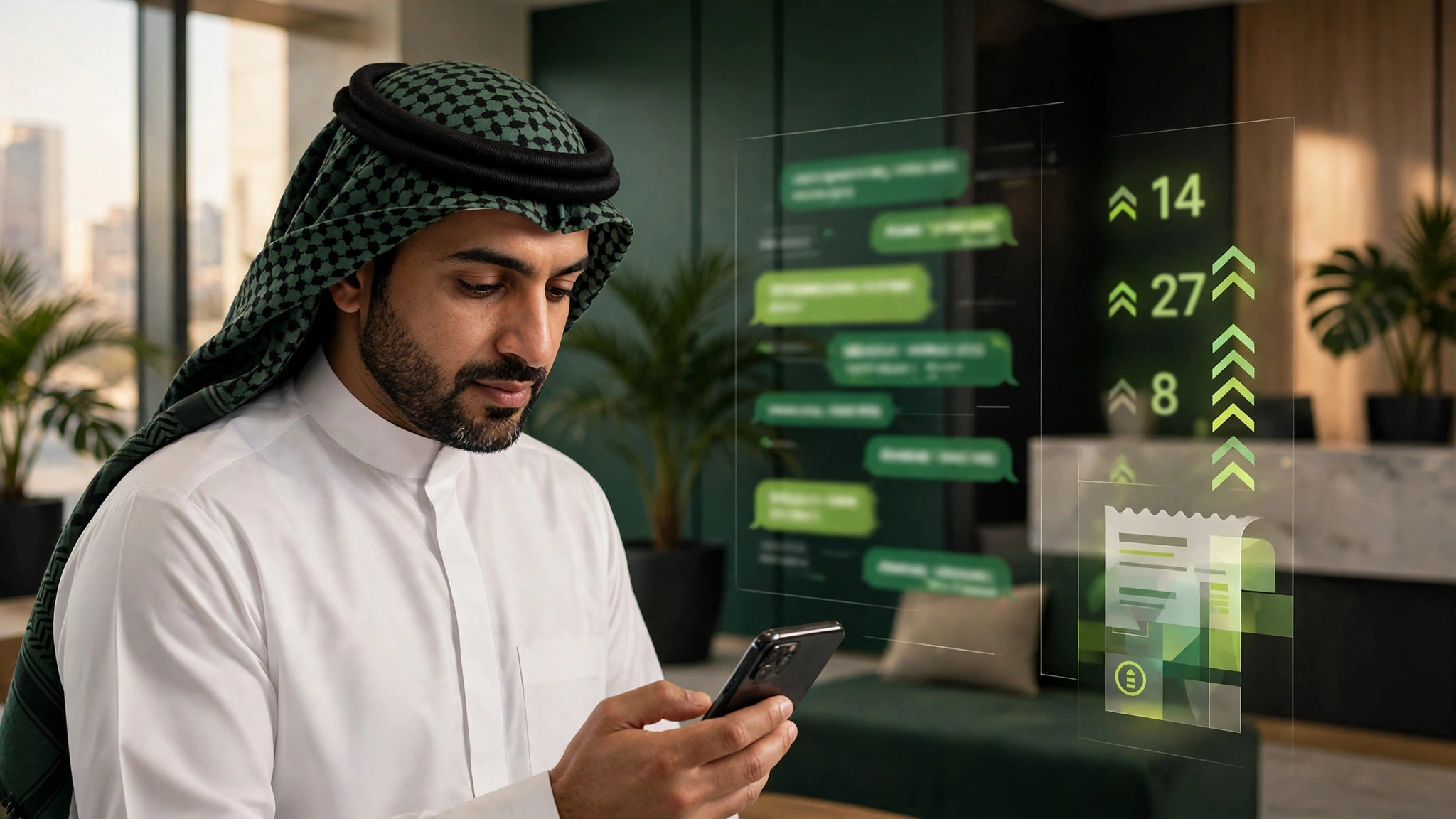
The short answer: WhatsApp AI is still legal and still worth it for Saudi and UAE businesses — but it stopped being free at volume. Since 1 October 2026, the first 1,000 service replies per number each month are free inside the 24-hour window; after that, Meta bills every reply at your country’s utility rate. And since 15 January 2026, general-purpose AI chatbots are banned from the platform outright — your own task-specific assistant (bookings, orders, support) remains fully allowed. Design for short conversations and the bill stays small. Design chatty, and you pay for every word.
The two rule changes, in plain terms
January: who is allowed. Meta barred AI providers from using the WhatsApp Business Platform to deliver general-purpose assistants — open-ended chatbots whose main product is the AI itself. A business automating its own customer conversations was never the target and is explicitly still allowed. We covered the January rules in full in our guide to what’s allowed for WhatsApp AI in Saudi Arabia & the UAE.
October: what it costs. Service conversations — a customer messages you, you reply within 24 hours — used to be effectively free at any volume. Now the first 1,000 replies per phone number per month are free; beyond that, each reply is billed at the utility rate for your country. Two details matter:
- Utility templates inside the window now cost money too. Order updates and reminders sent as templates are charged even when the customer wrote to you first.
- Click-to-WhatsApp ads still open a 72-hour free window. Conversations that start from an ad remain free for three days — which makes ad entry the cheapest front door you have.
Billing in Saudi riyals and UAE dirhams has been available since April 2026, so there is no currency excuse left for guessing your bill at month-end.
The new message math
Rates differ by country and conversation category, so check yours in Meta’s rate card before budgeting. The shape of the bill, though, is the same everywhere:
| Service replies / month | Free | Billable | What it means |
|---|---|---|---|
| 800 | 800 | 0 | You pay nothing. Most small businesses live here. |
| 3,000 | 1,000 | 2,000 | A busy clinic or salon. The bill is real but small next to one recovered booking. |
| 10,000 | 1,000 | 9,000 | An e-commerce or multi-branch operation. Conversation design now decides your margin. |
One worked example, labelled as an illustration: if your utility rate were $0.01 per reply, 9,000 billable replies cost $90/month. If your assistant averages three replies where one would do, that line quietly becomes $270. The rate is Meta’s. The multiplier is your design.
Why chatty assistants got expensive
The old design habit — long greetings, one question per message, “let me check that for you” filler — was free in 2025. In 2026 every one of those messages is a line item after your first thousand. The assistants that stay cheap share three traits:
- They finish in fewer messages. One message that asks for name, service and preferred time beats three messages asking one thing each.
- They hand over to a human fast. A human reply still counts as a service reply — but a stuck customer who needs twelve bot messages to reach a person costs twelve messages and the customer.
- They use templates deliberately. Reminders and updates are worth paying for when they prevent a no-show or a “where is my order” conversation. They are waste when they announce things nobody asked about.
What a compliant, cost-controlled build looks like
Task-specific, tied to your own systems, and budgeted per conversation:
- Scope: bookings, order status, FAQs, lead qualification — your business, your customers. Nothing general-purpose.
- Connected: your calendar, CRM or ordering system, so answers are real instead of scripted guesses.
- Human path: a person can take over at any point. This is not just good practice; it is how the platform is meant to be used.
- Cost controls: conversation-length targets, template audits, and a monthly message report — the same discipline you would apply to an ad account.
As planning ranges, a build like this typically runs $2,500–$7,500 depending on integrations, plus Meta’s per-message charges at your volume and any platform fees from your provider. Anyone quoting you a WhatsApp assistant without asking about your monthly message volume is quoting you half a product.
Where this breaks — read before you build
- If your customers need long, open-ended conversations (complex advice, negotiation), WhatsApp AI is the wrong tool; use it to book the call with the human instead.
- If you have no system behind the chat — no calendar, no order data — the assistant can only make conversation, and conversation is now the expensive part.
- If a vendor offers you a “ChatGPT for WhatsApp” as the product itself, that is the category Meta banned in January. Walk away.
How MaxCore builds WhatsApp assistants
Discovery first: we map your conversation types, estimate your monthly message volume, and cost the build and the running bill before anything is signed. Then a fixed-scope build — assistant, integrations, human handover, cost reporting — invoiced by milestone in SAR, AED or USD, under NDA.
Running WhatsApp AI in Saudi or the UAE? Book a free discovery call at https://calendly.com/maxcorepk/30min — bring your current message volume if you know it; you’ll leave with the new math for your business and a fixed first step.
Frequently asked questions
Is WhatsApp AI still allowed for businesses in 2026?
Yes. Your own task-specific assistant — bookings, orders, support for your own customers — is explicitly allowed. What Meta banned in January 2026 is general-purpose AI chatbots using WhatsApp as their distribution channel.
How much does WhatsApp charge per message now?
Service replies inside the 24-hour window: the first 1,000 per number per month are free, then each reply is billed at your country’s utility rate. Rates vary by country and category — check Meta’s current rate card for Saudi Arabia or the UAE before budgeting.
Do reminders and order updates cost money?
Yes, if they are sent as utility templates — they are charged even inside the 24-hour window. They earn their cost when they prevent a no-show or a support conversation; audit them monthly.
What does it cost to build a WhatsApp AI assistant?
As a planning range, $2,500–$7,500 for a task-specific assistant with real integrations (calendar, CRM, ordering), plus Meta’s per-message charges at your volume. The build quote should always come with a running-cost estimate.
Written by the MaxCore Technologies team. Drafted with AI assistance and reviewed against MaxCore’s delivery experience; prices and policy dates reflect Meta’s published 2026 changes, and cost figures are planning ranges, not quotes.







Add comment